Free Mental Math Worksheets (Smart Order)
Printable mental math worksheets for grades 2–4. Add and subtract three numbers in the order that makes it easy — like 62 − 21 + 22, where 22 − 21 = 1 first. Every download is a brand-new PDF.
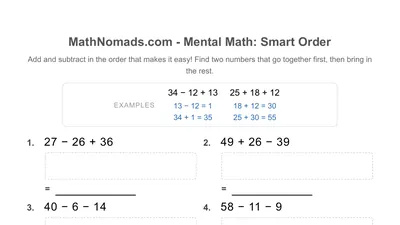
Mental Math: Smart Order (Two Digits)
Grade 2
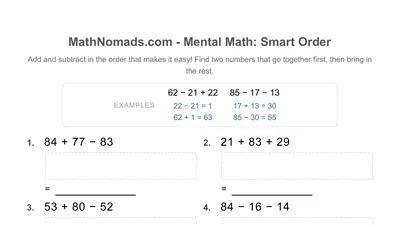
Mental Math: Smart Order
Grade 3
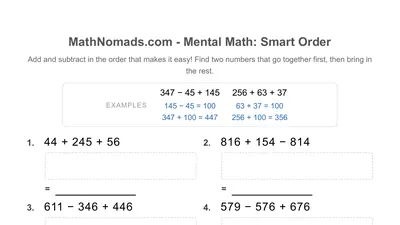
Mental Math: Smart Order (Three Digits)
Grade 4
About our mental math worksheets
Strong mental calculators don’t work left to right — they scan the whole problem for numbers that go together. In 62 − 21 + 22, spotting that 22 and 21 nearly cancel turns a two-step column calculation into "62 + 1". These worksheets are built so that every problem hides a friendly pair: two numbers that nearly cancel (38 − 37), differ by a round amount (45 − 35 = 10), or add up to a round number (17 + 13 = 30).
Rearranging numbers this way is the commutative and associative properties in action — the same properties behind later algebra — practiced the fun way. Grade 2 uses small two-digit numbers, grade 3 mixes all three pair types across two-digit numbers, and grade 4 moves to three-digit numbers with pairs that make hundreds (63 + 37 = 100). Two worked examples on every sheet show the strategy, and every download generates fresh problems.
Frequently Asked Questions
What is the "smart order" strategy?
Addition can be done in any order, and subtracting a number works the same wherever it appears. So in 62 − 21 + 22 you may pair 22 − 21 = 1 first, then add 62. Finding the easy pair first turns hard-looking problems into one simple step.
Why does rearranging always work?
Because of the commutative and associative properties of addition. Treat each number with its sign (+22 and −21 in the example) and you can group them in any order without changing the answer — the same idea students later rely on in algebra.
What grades are these worksheets for?
Grade 2 (small two-digit numbers), grade 3 (all pair types with two-digit numbers), and grade 4 (three-digit numbers). They also make great warm-ups or number-talk prompts for older students.