Free Rounding Worksheets
Round to the nearest 10 or 100 the hands-on way: write + or −, fill in the distance to the round number, and write the answer — like a column addition problem.
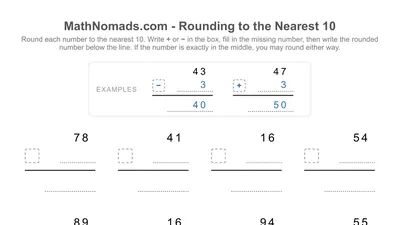
Rounding to the Nearest 10
Grade 2
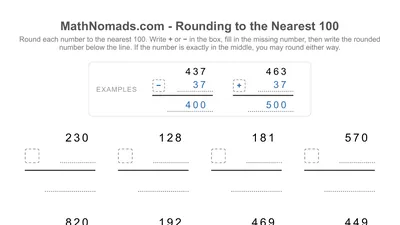
Rounding to the Nearest 100
Grade 3
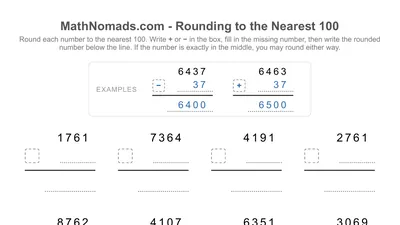
Rounding 4-Digit Numbers to the Nearest 100
Grade 4
About these rounding worksheets
Most rounding worksheets just ask for the answer, which children can produce by memorizing a digit rule without understanding it. These worksheets make the thinking visible: each problem is laid out like a column addition, and your child writes + or − in the box, fills in the distance to the nearest round number, and writes the rounded result below the line — for example 437 − 37 = 400, or 463 + 37 = 500.
Deciding between + and − forces the real question behind rounding: is this number closer to the round number above it or below it? A number past the midpoint rounds up; before the midpoint it rounds down; exactly on the midpoint, either answer is accepted. Two worked examples at the top of every sheet show exactly what to do. Grade 2 rounds two-digit numbers to the nearest 10, grade 3 rounds three-digit numbers to the nearest 100, and grade 4 extends to four-digit numbers.
Frequently Asked Questions
What grade do kids learn rounding?
Rounding to the nearest 10 and 100 is a grade 3 standard in most curricula, but the idea of "which ten is closer" is accessible in grade 2 once children know two-digit place value. Our grade 2 sheet (nearest 10) is a gentle introduction, and the grade 3 and 4 sheets match classroom expectations.
Why fill in + or − instead of just writing the rounded number?
Writing the sign and the distance shows whether a child truly understands that rounding means finding the closest round number, rather than applying a memorized digit rule. It also quietly practices mental addition and subtraction to the next ten or hundred.
What happens on a midpoint like 450?
A number exactly in the middle, like 45 or 450, is the same distance from both round numbers, so the worksheet instructions allow rounding either way. (Schools usually teach rounding up, and that answer is always acceptable.)